Search "bookkeeping search engine optimization firm" right now and watch what Google does.
Under half the results on page one, you'll see a small gray line underneath the snippet: Missing: bookkeeping.
Google is telling you, in plain language, that it couldn't find enough pages actually about bookkeeping to fill a page of results. So it substituted. Every firm ranking there sells SEO to accountants and CPAs, and Google is stretching those pages to cover a search they don't really match.
That gap is the reason this article exists. If you run a bookkeeping practice in Oakland or anywhere in the East Bay, the firms competing for your business are running an accounting playbook and hoping it fits your firm.
It mostly doesn't. Here's what's actually different, the four things a good firm should get right on your site, and what happened when we ran this for a practice in Hayward.
Bookkeeping Is Not Accounting. Not to Google, Anyway.
An accounting firm and a bookkeeping firm look similar from the outside. To a search engine, they serve two different people.
Someone searching for a CPA usually has a deadline. They need a return filed, an entity structured, an IRS letter answered. It's transactional, it's seasonal, and it spikes hard between January and April.
Someone searching for a bookkeeper has an ongoing problem. Their books are behind. Their QuickBooks file is a mess. They hired their third employee and payroll stopped being something they could handle on a Sunday afternoon. That search runs year-round, and it's shopping for a relationship, not a transaction.
Different urgency, different language, different timing. When an agency optimizes you for CPA terms, it's pointing your site at a keyword set that only partly overlaps with the one your actual buyers use.
You can see what that mismatch costs right on the results page. Half the firms selling accounting SEO can't rank for a bookkeeping search without Google flagging that their page is missing the word.
SEO for Bookkeepers: The Keywords You Should Actually Own
Ask any firm you're considering which terms they'd target for you. If the answer is "bookkeeping services" and nothing else, keep interviewing.
The searches that bring in bookkeeping clients fall into a few families, and each one is a different person with a different problem:
- Service plus city. "Bookkeeper Oakland," "bookkeeping services Berkeley." Highest intent, lowest volume, and the ones that actually convert.
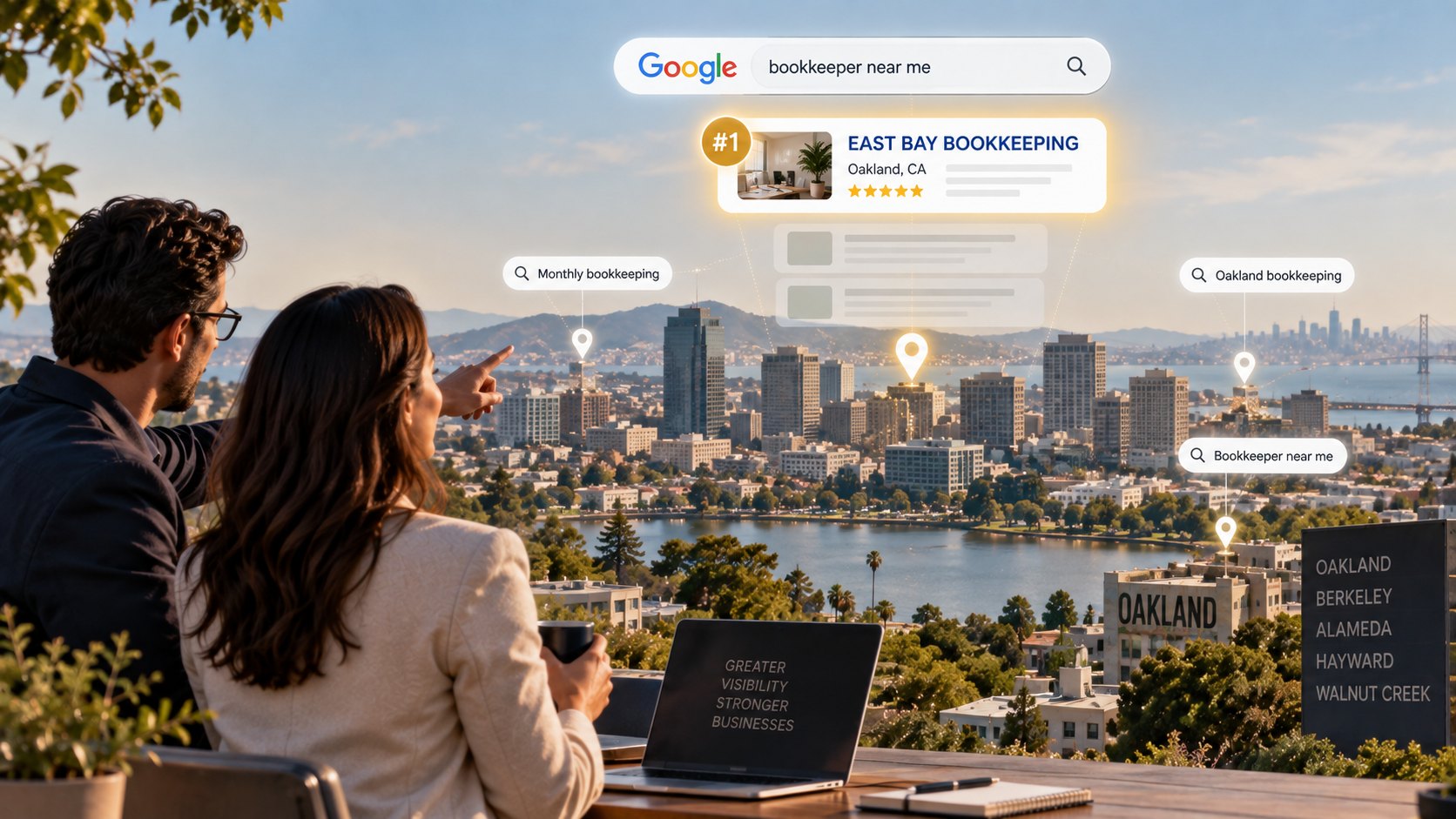
- Near-me searches. "Bookkeeping service SEO near me" is how firms find us. "Bookkeeper near me" is how your clients find you. Both are won the same way - a Google Business Profile with location pages behind it that back up the claim.
- Software-specific. QuickBooks cleanup, Xero migration, QuickBooks Online setup. Someone running this search has already diagnosed their own problem and is ready to pay someone to fix it.
- Situation-specific. Catch-up bookkeeping, back bookkeeping, monthly bookkeeping, year-end cleanup. These people are in pain, which makes them the best leads on this list.
- Adjacent services. Payroll plus city, controller services, 1099 filing.
Notice what isn't here: nothing says "tax preparation." That's the whole point. The best SEO keywords for bookkeeping services describe an ongoing operational problem, not an annual filing deadline - and any list of SEO keywords for bookkeeping that reads like a CPA's list was built for the wrong firm.
The 4 Things We'll Help You Get Right
Rankings are the scoreboard. Your website is the machine. Most of what separates a bookkeeping search engine optimization firm that produces booked calls from one that produces a nice-looking traffic chart comes down to four things on the site itself.
Ask about all four. The answers will tell you a lot.
1. Site Speed
Here's the standard I hold sites to: under one second on desktop, under a second and a half on mobile.
Under two seconds is decent. Under three is possibly tolerable. Slower than that and you're paying for traffic that leaves before it ever sees your offer.
And it's the whole site, not the homepage. Your homepage is usually the fastest page you own, because it got the most attention. The pages that actually receive search traffic - your service pages, your location pages - are the ones quietly loading in four seconds with an uncompressed hero image sitting on top of them.
The vetting question is simple: ask what your site loads in right now, on mobile. A firm that's serious will have checked before the call. A firm that has to get back to you hasn't opened your website yet, which tells you exactly what the first month is going to feel like.
Speed is also the cheapest win on this list. It's usually image compression, a lighter theme, and cutting the plugins nobody uses. We handle it as part of how we build, which is why it shows up in our web design work as much as in our SEO.
2. Location Pages

If you serve Oakland, Berkeley, Alameda, San Leandro, Hayward, and Walnut Creek, you need a page for each one. Not a dropdown. Not a list of cities in your footer. A real page.
Most agencies build these badly. They write one page, swap the city name, and publish six versions of the same thing. Google has been able to spot that for a decade, and thin doorway pages are worse than having no page at all - they drag down the rest of your site along with themselves.
A location page earns its place when it's genuinely about that place. What kinds of businesses you serve there. Local filing or permitting quirks. A client story from that city. Whether you meet in person or work remotely for that area.
That's more work. It's also the difference between actually ranking for bookkeeping SEO in Oakland, CA and owning a folder of empty pages.
If local visibility is the whole reason you're hiring someone, our Oakland local SEO work is the closest thing to a preview of how we approach it.
3. Service Pages
Same principle, different axis.
Most bookkeeping sites have one page called Services that lists everything the firm does in a bulleted column. That page competes for nothing, because it isn't really about anything.
Monthly bookkeeping, catch-up and cleanup work, payroll, QuickBooks setup, controller services - those are five different searches, run by five different people, with five different budgets. Someone searching for catch-up bookkeeping has eighteen months of unreconciled transactions and a deadline. Someone searching for controller services is scaling. They should not land on the same page.
One page per service. Each written for the person running that specific search, with its own title, its own copy, and its own call to action.
This is also where you find out whether a firm is going to write anything at all. Plenty of SEO shops will happily build you a technical foundation and then hand you a content calendar to fill in yourself. Ask directly who writes the service pages.
4. A Contact Form, or a Booking Widget?

Almost nobody asks about this one, and it decides what your traffic is actually worth.
A contact form is fine - if you have a real place those emails land and a real process for triaging them. That setup makes sense when a lot of your pre-sale conversation happens over email anyway, which for some firms it genuinely does.
But here's what I've seen consistently: a booking widget produces both more inquiries and a higher show rate.
The reason is that a form makes the next step your problem. Someone raises their hand, and now you're chasing them to get on a call. A booking widget lets them pick the time themselves, which means the people who book are the people who meant it. And because they've told you what they need while scheduling, you sit down already knowing what the conversation is about instead of spending the first ten minutes finding out.
One more thing that lands with this audience specifically: something like TidyCal is a one-time payment. You buy it once and it's an asset on your site for its foreseeable lifetime - not another monthly subscription line on books you're already working to keep clean.
Oakland and the East Bay: The Highest-Leverage Channel Nobody Is Pointed At

We sit twenty minutes from one of the densest concentrations of technology money on earth, and the gravity here pulls almost entirely toward social media.
I watch small firms across the East Bay pour real hours into posting, and most of it never turns into revenue. It generates activity. It generates the feeling of marketing. It rarely generates a phone call from someone who needed a bookkeeper that week.
Search works the other way around. It's slower to start, and it compounds. Every month of visibility makes the next month cheaper, because the rankings you earned in month four are still working in month twelve without you feeding them. And someone who finds you by searching "bookkeeper near me" already has the problem you solve.
That's what makes this such high-leverage ground right now: most firms in Oakland and the greater Bay Area simply aren't pointed at it. Which means the ones who do pour fuel into this engine aren't just getting ahead - they're opening a gap that gets progressively harder for anyone else to close. Search is winner-take-most, and the firm sitting in the top three when a competitor finally decides to start is very hard to dislodge.
The other half of that compounding is authority. Content makes you eligible to rank. Links are a large part of what decides whether you actually do.
What This Looked Like for a Hayward Firm
We ran exactly this for an accounting and bookkeeping practice in Hayward.
She came to us buried. Her tax preparation terms sat on page seven. Her bookkeeping terms were a little better at page two - but page two is still nowhere, because almost nobody clicks past the first page.
We built out blog pages carrying her geo-targets alongside her actual bookkeeping service information, so every page had a reason to exist beyond a city name in the title. Then we put a planned link-building infrastructure underneath the whole thing rather than acquiring links at random.
Tax preparation terms went from page seven to page one. Bookkeeping terms went from page two to page one. She reached number one in her area, and she got there faster than I expected.
The part I care about more: she ended up hiring staff to keep up with the calls. That's the version of an SEO result that shows up on a P&L instead of in a dashboard. The full breakdown is in her case study.
What to Ask a Bookkeeping SEO Company Before You Sign
Short list. Take it to every firm you're considering:
- What does my site load in right now, on mobile? (If they don't know, they haven't looked.)
- Which specific keywords would you target, and how many are bookkeeping terms rather than tax terms?
- How many location pages, for which cities, and who writes them?
- Do you build a separate page per service, or one services page?
- Are you setting up a form or a booking widget, and why that one?
- How are you acquiring links, and can you show me a real placement?
- What does month-three reporting look like, and what number are we judging this on?
The last one matters most. A bookkeeping SEO company that can't tell you in advance what success looks like in ninety days is planning to show you a traffic chart and hope you're satisfied with it.
The Short Version
The reason this is worth doing now is the same reason it was worth writing: Google is openly short on pages about bookkeeping. That's a gap, and gaps close.
If you're choosing a bookkeeping search engine optimization firm, the four things above will tell you more in a single conversation than any pitch deck will. Site speed. Location pages. Service pages. How you capture the person who raised their hand.
We do this for accounting and bookkeeping practices across Oakland and the greater Bay Area. If you want to know what it would take for your firm, let's look at your site together.