SEO has picked up a new set of letters lately. EEAT, GEO, AEO. Every one of them gets treated like a brand new discipline.
And every one of them is really describing the same underlying question: does Google, and now the AI systems parsing the web alongside it, trust that your firm is who it says it is.
The labels keep changing because LLMs are now part of how that trust gets calculated too. What hasn't changed is the single strongest signal outside your own website that answers that question: backlinks.
What a High-Authority Backlink Actually Means

A high-authority backlink isn't just a high domain rating number. It's three things at once: the site is relevant to your niche, it has real traffic, and the placement came from an actual editorial relationship, not a listing on a network.
Any one of those missing weakens the link. All three together are what actually move a Bay Area CPA or accounting firm up the rankings.
The Landscape, Named Honestly

Not every link-building tactic belongs in the same category. Here's how they actually break down:
The sustainable set:
- Citations. Consistent business listings across the directories that matter, the foundation everything else builds on.
- Guest posts. Placed through real publisher relationships, not marketplaces. See our Guest Post Buyer's Guide for exactly how to vet these.
- Press releases. Fast, broad distribution when there's genuine news behind it. Covered in Guest Posts vs. Press Releases and the 5 mistakes to avoid.
What we don't use:
- Private blog networks. Templated placements sold to whoever pays, regardless of niche. Google's systems are built to catch this pattern.
- Parasite links. Content hosted on someone else's high-authority domain just to borrow its ranking power. It doesn't build your own site's authority and it doesn't last.
We also don't stack Google Maps listings as a shortcut. It's a tactic that trades short-term visibility for long-term risk, and it's not something we run for clients.
The Sequence We Actually Use
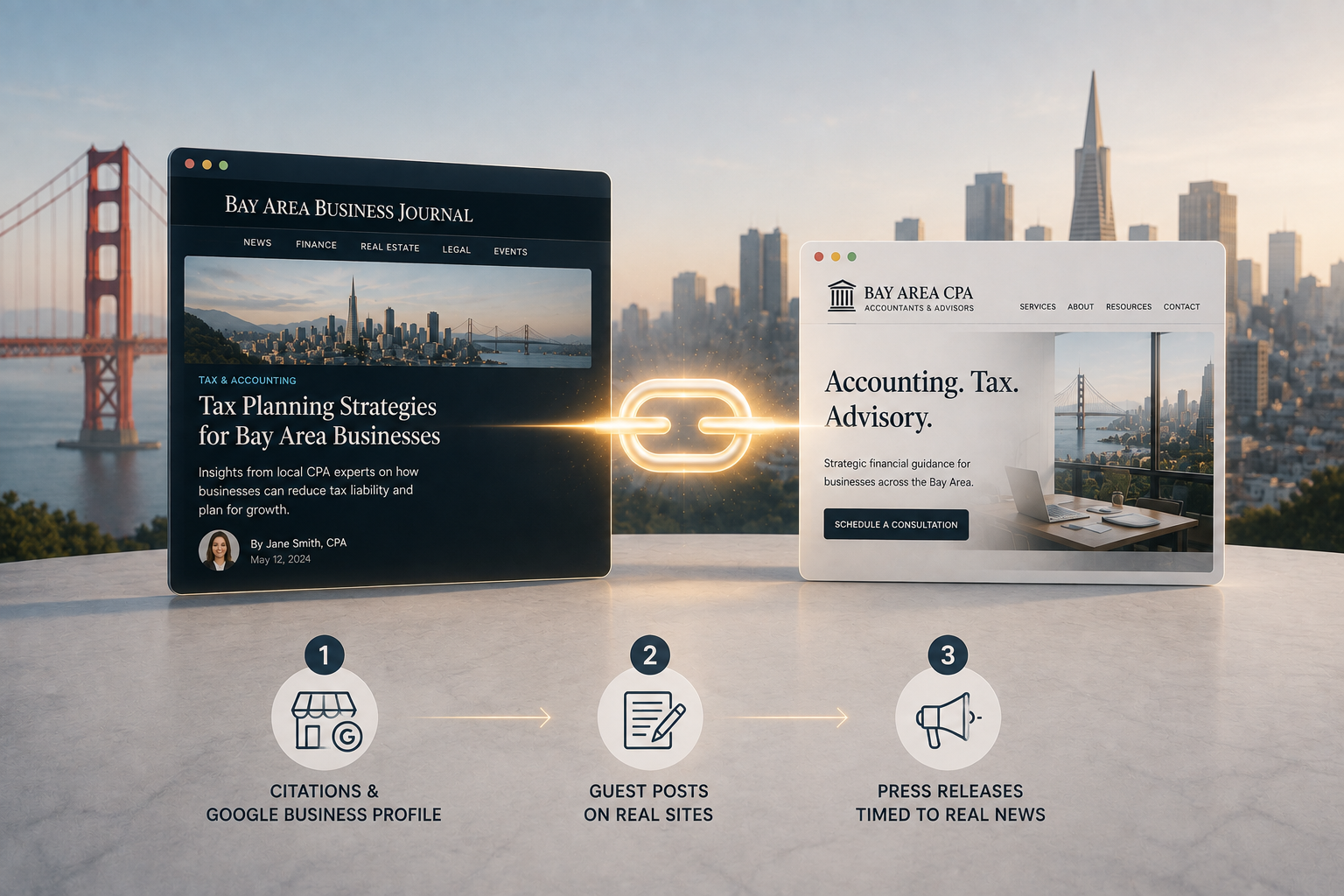
Order matters more than any individual tactic. For Bay Area CPA and accounting firms, it looks like this:
- Citations and Google Business Profile, dialed in first. This is the foundation. Nothing else compounds properly without it.
- Guest posts on real, niched, high-traffic sites, placed with real buyer-fit audiences, not just high numbers.
- Press releases, timed to genuine news, not filler.
Cadence matters too. Most firms do well running somewhere between two and ten press releases a year, and a similar range of guest posts, scaled to the size of the firm and how much real news and content they're actually generating.
Why This Lever Doesn't Go Out of Style
Every year brings a new acronym for how search and AI systems evaluate trust.
Backlinks keep showing up as the strongest external signal in all of them, because a real link from a real, relevant site is still the clearest evidence the internet has that someone else vouches for you.
That's not going away just because the label changed.
Where to Go From Here
If you haven't already, start with our SEO for Accountants guide for the full picture.
From there, the Guest Posts vs. Press Releases breakdown and the Guest Post Buyer's Guide cover the two tactics in depth.
If you'd rather have us build this out for you, backlink strategy for Bay Area CPA and accounting firms is a service we run every day. Reach out and we'll show you exactly where your firm stands and what to do next.